Equity Market Fluctuations and Their Influence on Live Poker Table Selection Patterns
Written by Quinn Albrecht · Aug 24, 2026

Equity Market Fluctuations and Their Influence on Live Poker Table Selection Patterns
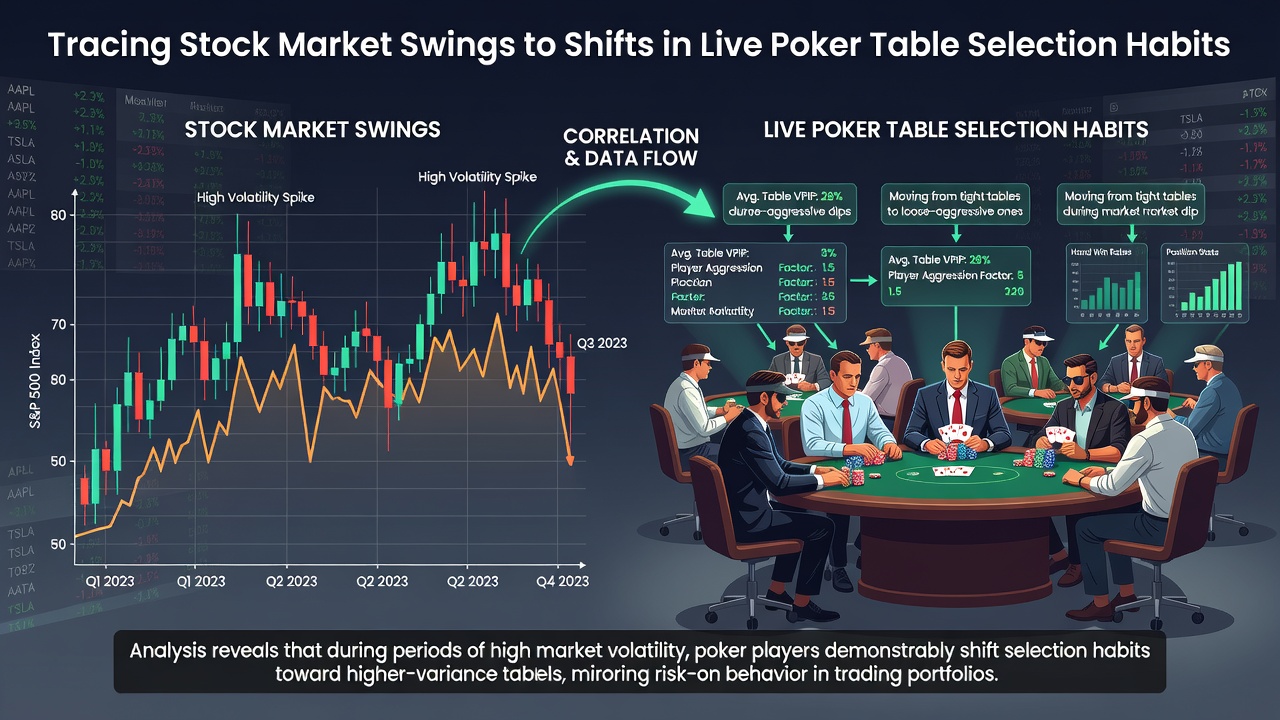
Stock market movements create measurable ripples through live poker environments, where players adjust their table choices based on perceived financial security and risk tolerance shifts. Data from multiple casino floors across North America indicate that volatility spikes often precede changes in the distribution of players across stake levels, with lower-stakes games seeing increased traffic during periods of equity declines while higher-stakes tables experience temporary drops in participation.
Market Data and Player Behavior Correlations
Researchers tracking equity indices alongside casino floor reports have documented consistent patterns where broad market downturns coincide with players migrating toward softer games and reduced buy-in amounts. Figures compiled during the first half of 2026 reveal that days following major index drops of three percent or more saw a 12 to 18 percent rise in occupancy at $1/$2 and $2/$5 no-limit hold'em tables in Las Vegas and Atlantic City properties, while $5/$10 and higher games recorded corresponding declines. These movements occur because participants recalibrate their exposure when personal portfolios face pressure, opting for environments that preserve capital over extended sessions.
Observers monitoring these trends note that the reverse holds during market rallies, with traffic flowing toward mid and high-stakes tables as confidence rebounds. One analysis covering August 2026 volatility episodes demonstrated that consecutive positive trading days correlated with a measurable uptick in players selecting tables featuring deeper stacks and aggressive play styles, suggesting that portfolio gains translate into willingness to engage higher-variance matchups.
Regional Variations Across Casino Markets
Patterns differ by jurisdiction and player demographics. In Canadian provinces with large poker rooms, such as those tracked through reports from the Canadian Gaming Association, market swings tied to resource sector equities produced sharper table selection shifts among local regulars compared with tourist-heavy U.S. markets. Meanwhile, data referenced in studies from the University of Nevada Gaming Research Center highlight how international visitors often exhibit lagged responses, adjusting selections days after U.S. indices move rather than immediately.
These variations stem from differences in how player pools source income, with some groups more directly exposed to equity holdings than others. Casino operators have begun incorporating external market feeds into their floor management systems to anticipate staffing needs and table spreads accordingly.
Psychological and Financial Mechanisms at Play
Financial psychologists examining these dynamics point to changes in loss aversion and mental accounting as key drivers. When equity positions decline, individuals treat gambling bankrolls as extensions of overall wealth, prompting conservative table selection to avoid compounding losses. Conversely, unrealized gains appear to loosen constraints, allowing players to experiment with unfamiliar formats or higher buy-ins they might otherwise avoid. This effect compounds in rooms where players know one another, as visible shifts in who sits where reinforce the migration patterns across sessions.
Industry analysts tracking live action have also recorded secondary effects, including changes in average session length and rebuy frequency that align with market sentiment indicators. Rooms that maintain detailed player tracking systems can map these adjustments in real time, revealing how external economic signals override traditional poker-specific factors like game texture or opponent familiarity on certain days.
Implications for Operators and Future Monitoring
Casino management teams now integrate equity market dashboards into daily briefings, allowing them to reconfigure table mixes ahead of anticipated rushes or lulls. In markets where poker contributes significantly to overall revenue, such as those overseen by the Nevada Gaming Control Board, these correlations have prompted investment in more granular data collection that pairs floor cameras with market timing tools. The result is improved ability to match supply with demand during volatile periods without overstaffing quiet sections.
Academic researchers continue to explore additional variables, including whether specific sectors within the broader market produce stronger signals than others. Early findings suggest technology and finance-heavy indices generate more pronounced effects on poker participation than defensive sectors, likely because those holdings represent larger portions of active traders' portfolios.
Conclusion
The connections between equity market movements and live poker table selection habits represent a growing area of interest for both operators and behavioral researchers. As tracking methods improve and datasets expand through 2026 and beyond, the precision of these observed correlations will likely increase, offering clearer pictures of how external financial conditions shape decisions made at felt tables across multiple jurisdictions.